Our products

Electronic Signature

Collection of Payments

Companies

Small Businesses

Medium Businesses

Large Companies

Industries and departments

Legal Services

Construction

Accounting

Government and Municipalities

Education

Human Resources

Sales

Industries and departments

Legal Services

Construction

Accounting

Government and Municipalities

Industries and departments

Education

Human Resources

Sales

Developers

API Pricing

API Documentation

Our sales team is here to help you explore the right plan for your needs and answer any questions you may have.

Read more

About EzSign Icon

About Us

Customer Testimonials Icon

Customer Testimonials

Blog Icon

Blog

FAQs

How to

Icon tutorials

Tutorials

Video Guides Icon

Video Guides

Get Support Icon

Contact

Compare

Versus Icon

eZsign vs Docusign

Versus Icon

eZsign vs Acrobat Sign

30 Days Free - No Credit Card Needed!

30 day free trial, no credit card required

What is proof of evidence for electronic signatures?

Learn why proof of evidence is such an important e-signature solution feature for proving authenticity, and what it means if you don’t have it.

Back before computers, paper documents were signed with pen and ink. To prove that the signers were who they said they were, we developed safeguards, like having a witness present to sign the same document or relying on a licensed notary public to verify signers’ identities and log the document type, signature date, and other key information in their notary journal. Along with the signed paper documents, these records and witnesses were available to serve as evidence in court if needed.

Today, things are a little different.


Establishing an e-signature audit trail

Our computers don’t have little gnomes inside them to help us notarize our digital documents. Some platforms do allow notaries to intervene in signing sessions and notarize digital signatures, but this isn’t always needed and usually doesn’t involve all the parties in the signing session.

Even when a notary is involved, the digital audit trail is just as important. To satisfy this requirement, e-signature platforms create proof of evidence files, which are the digital summaries of the platforms’ detailed audit trails. When proofs of evidence meet certain standards, they are sufficient to ensure signatures hold up in court. With a detailed proof of evidence log and a streamlined e-signature solution, you’ll have everything you need for legally binding signatures and a better user experience—no notary required.

Not all proof of evidence files are created equal. Some might just list the signer names, date of signature, time of signature, and the document name. This may not be enough to demonstrate the validity of the signature in a court of law.

What key information is in proof of evidence files?

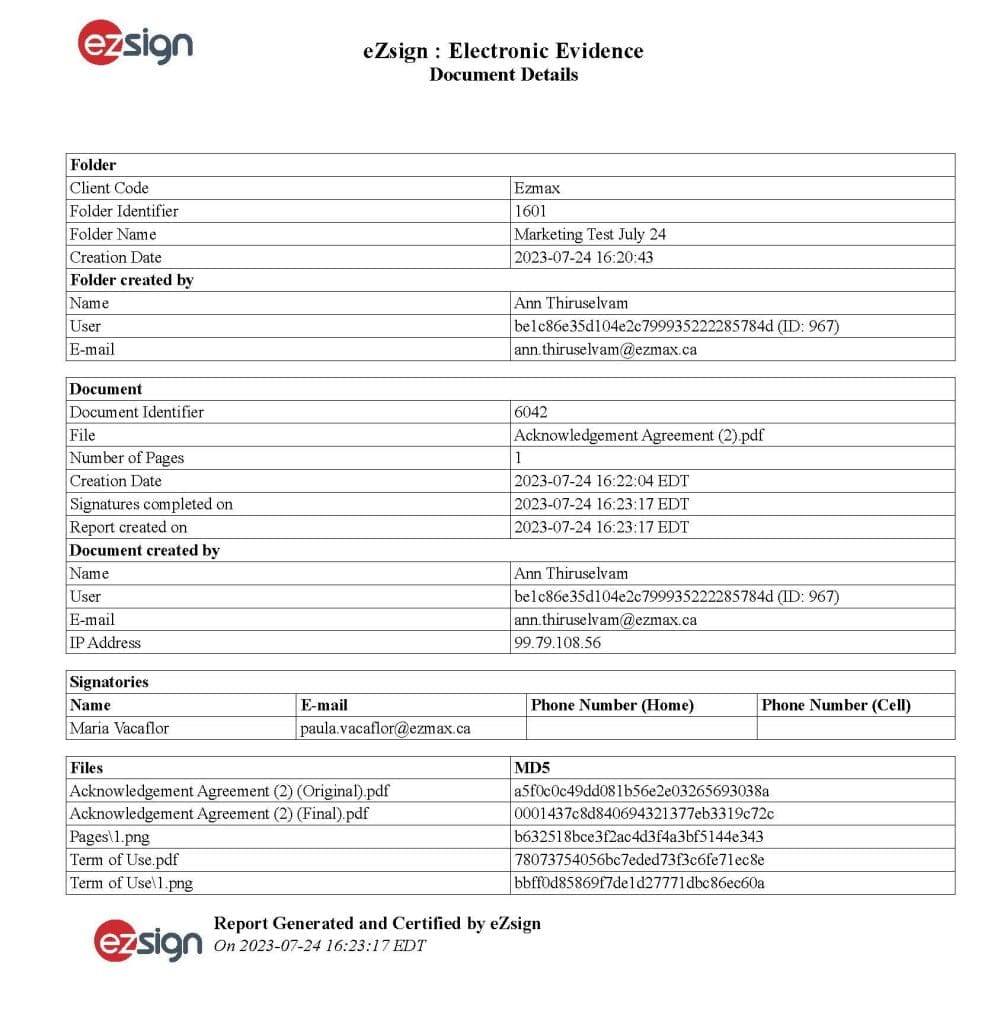
To satisfy the burden of proof for electronic signatures and ensure you can sign documents with peace of mind, your proof of evidence file should at least have the following:

  • Document information, including the name and number of pages
  • Identifying information for the signing session creator
  • Signer names and contact information, proven by multiple authentication methods and IP addresses
  • Log of every time the document was viewed, sent, printed, signed, or modified, with timestamps provided by an independent time-stamping authority


When the proof of evidence file provides this level of detail, it satisfies the requirements provided by Canadian legislation, regulation, and case law for authentic electronic signatures.

An example of an eZsign e-signature Proof of Evidence file

In fact, with a proof of evidence file, you actually have more information about your signers and your document than you would have had before computers. This makes it even easier to prove the validity and legal weight of an electronically signed document, especially if it is challenged in court. If you’re signing important documents electronically, you won’t want to do it without the audit trail provided in a proof of evidence file.


Secure, authentic e-signatures

So that your e-signatures hold up in court, make sure your provider’s audit trail is sound and that the proof of evidence file contains everything you’ll need to prove your e-signatures are authentic and your documents untampered with. If you’re not sure whether your proof of evidence passes the test, make sure to ask! If you need a second opinion, our e-signature experts would be more than happy to assist you.

This article in no way constitutes legal advice. Always consult with counsel for all your legal and contractual questions.

Share   |